


Need for Speed™ No Limits
ELECTRONIC ARTS
I installed Need for Speed™ No Limits expecting a quick mobile racer, and that is exactly where it makes its best first impression. A race begins with a burst of speed, traffic appears almost immediately, and the controls are simple enough that I can focus on choosing the next move rather than learning a complicated button layout. It is a free racing game from ELECTRONIC ARTS, available for Android devices running version 6.0 or later, and it has grown into one of the most familiar names in mobile street racing.
What kept me playing was not simply the licensed-car fantasy or the familiar Need for Speed identity. The stronger hook is the rhythm between action and response: I steer through a dangerous gap, clip a ramp or drift around a corner, see the race improve, and then want another attempt because the previous run was almost better. That cycle is fast, readable, and designed for short bursts. At the same time, the game is not a perfect fit for every racing fan. Its free-to-play structure, touch controls, and focus on repeated progression can feel restrictive if you want a traditional console-style racer with complete freedom from timers or purchases.
How the first race teaches you to drive
The opening experience is built around immediate movement. Instead of asking me to spend a long time tuning menus or studying a track, the game puts the car on asphalt and lets the road explain the basics. Steering is handled with swipes, while actions such as drifting and using nitro become part of the same instinctive flow. I found the arrangement approachable on a phone because the controls leave the screen relatively clear, which matters when the road is crowded and the next bend arrives quickly.
That simplicity does not mean the driving is entirely automatic. The important decisions happen in small windows. I have to decide whether a drift is worth starting before a corner, whether a rival can be passed safely, and when nitro will produce a useful advantage instead of being wasted on a straight stretch. Traffic turns these choices into quick reactions. A clean line can make a short race feel controlled, while one late swipe can send the car into a barrier and erase the advantage I had built.
The first action is therefore more than “hold the accelerator.” It is a compact lesson in positioning. Staying near the best part of the road, using the outside of a turn to prepare a drift, and leaving room for traffic are more valuable than simply moving the steering gesture as quickly as possible. New players may initially overuse drifting because it looks dramatic, but I found that a shorter, calmer slide is often better than a long sideways movement that loses speed or ends in a collision.
Related News

Why WhatsApp Messenger Still Makes Everyday Communication Feel Easy

Jurassic World: The Game Is the Better Dino Tycoon for Strategic Players

Threads in Real Life: Who Should Join, Lurk, or Leave

How SHEIN Turned Shopping Into an Endless Content Feed

How to Make Fortnite Feel Smarter on Mobile

Should You Switch to Microsoft Outlook on Mobile?
There is also a useful distinction between playing for survival and playing for style. If I only want to finish, I can take safer lines and save nitro for recovery or a final push. If I want a stronger result, I need to take more risks around traffic, corners, and jumps. That makes the early races a gentle introduction to the game’s real question: how much danger is worthwhile for a better finish?
The feedback rhythm makes short races feel active
Every few seconds, the game gives me something to react to. A successful drift, a close pass, a jump, or a well-timed nitro burst changes the feeling of the run immediately. The car accelerates, the road rushes toward me, and the visual response confirms whether the decision worked. This feedback is the reason a brief race can feel more substantial than its length suggests.
I especially like the way mistakes are easy to understand. When I hit traffic, I know the problem was usually my line or timing. When a rival pulls away, I can often identify the missed opportunity: a corner entered too slowly, a nitro burst used too early, or a drift that carried me too far from the racing line. The game does not require me to analyze a replay to understand the basic cause. That clarity encourages another attempt instead of making failure feel mysterious.
Gallery
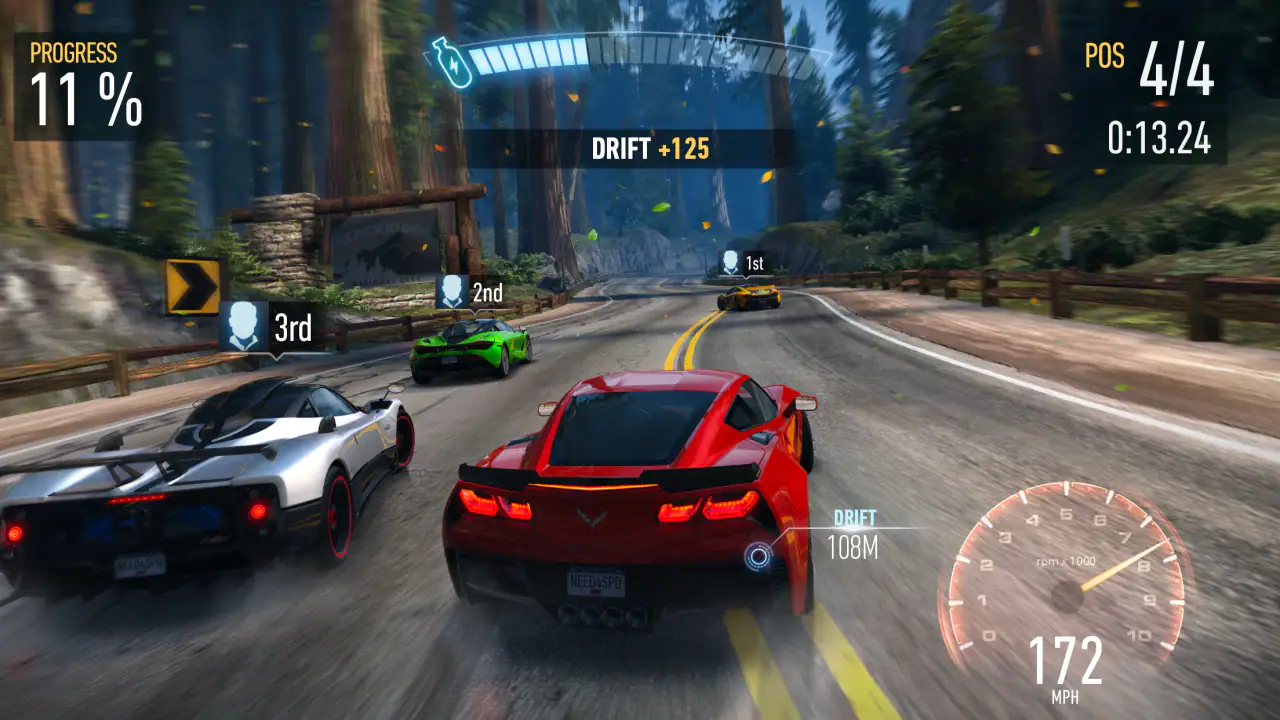
Still, the touch controls have limits. Swiping is comfortable for broad steering, but it offers less precise feedback than a physical controller. On a tight section, I sometimes make a correction that is technically sensible but too large for the game’s interpretation. Players who enjoy exact braking points, manual gear changes, or highly detailed car control may find the handling simplified. This is an arcade racer first, not a simulation.
The arcade approach works best when I treat the road as a sequence of opportunities. A corner is not only something to survive; it is a chance to build speed through a drift. A rival is not just an obstacle; it is a prompt to choose a side and commit. Traffic is not background decoration because it changes the route I can safely take. Once I started reading the road this way, the races became less about frantic swiping and more about preparing the next action before the current one ended.
Why the reward arrives quickly but progress still takes patience
Finishing a race gives the session a clear payoff. I can see progress toward improving my garage and taking on tougher events, which gives even a short run a purpose. The reward is not limited to winning perfectly. A near miss, a clean drift, or a fast section can make a run feel productive, especially when I am trying to improve a particular weakness rather than simply collect victories.
The garage is where the game’s longer-term motivation becomes more visible. Better performance changes how forgiving the car feels in later events, and upgrading gives me a reason to return to earlier activities. I often found myself replaying a race not because it was unfamiliar, but because I wanted a cleaner result or needed to strengthen the car before moving forward. That creates a useful relationship between immediate driving skill and longer-term preparation.
However, the progression also creates the main free-to-play friction. The game includes in-app purchases ranging from $0.99 to $99.99 per item. I can play for free, but the presence of paid options affects how I view the pace of advancement. A player who wants to move through the game quickly may feel pressure to spend, while a patient player can treat the progression as part of the experience and accept that improvement will take repeated races.
My advice is to decide early which kind of player you are. If you enjoy building a car gradually and do not mind revisiting events, the free structure is easier to live with. If you expect to unlock everything rapidly or want every new car available as soon as possible, the game may become frustrating. Spending can reduce waiting or speed up progress, but it does not replace the need to learn the road. A poorly timed drift remains poorly timed even when the car is stronger.
One practical habit helped me avoid wasting effort: I stopped upgrading everything evenly. When a car was close to meeting an event requirement, I focused on the performance area that most directly improved its behavior in races rather than spreading resources across every option. That approach made the garage feel less like a checklist and more like a set of decisions. It also reduced the temptation to chase every possible improvement at once.
The reset is part of the design, not a failure of the game
After a race ends, the game quickly points me toward the next objective. That fast reset is important because the individual events are easy to understand and usually leave me with a specific reason to continue. Maybe I missed a corner, need a stronger car, or simply want to beat the result I just achieved. The next session begins before the excitement has completely faded.
This is where the game is particularly effective for everyday use. I can play during a short break, complete a race, and stop without needing to reserve an entire evening. Later, I can return and immediately understand what I was working toward. The compact structure suits a phone better than a racing game that demands long uninterrupted championships.
A realistic example is a commute or lunch break when I have only a few spare minutes. I might start one event intending to play once, then repeat it because a late crash spoiled an otherwise strong run. The second attempt is not identical emotionally: I already know where the danger is, so I enter the corner earlier, save nitro for the exit, and try to turn the previous mistake into a small victory. That is the action-feedback-reward-reset loop in its clearest form.
The same reset can become repetitive. If I am not in the mood to repeat a route, improve a car, or work through another progression step, the game offers less variety than a broad racing sandbox. Its strength is focused momentum, not open-ended wandering. Players who want to choose any car, explore a large world, and create their own races may prefer a different type of mobile racer.
I also would not choose it as my first recommendation for someone who dislikes in-app purchases on principle. The free entry is attractive, but the progression model is always present in the background. Likewise, players looking for realistic physics, deep manual controls, or a relaxed driving game should look elsewhere. The speed, traffic, and repeated events are designed to keep attention high, not to provide a calm simulation.
Where it sits among mobile racing alternatives
Compared with a realistic racing simulator, this game is easier to pick up and more dramatic from the first minute. I do not need to understand tire behavior or manage a full set of driving inputs before having fun. The trade-off is reduced precision. A simulator gives me more control over the car and usually rewards careful technical driving, while this game rewards timing, swipes, risk-taking, and quick adaptation to traffic.
Compared with an open-world driving game, it is more directed. I am usually chasing a defined racing objective rather than inventing my own route or spending time simply cruising. That focus makes it better for short sessions and clearer progression, but less satisfying for players who see the car as a tool for exploration. It is also different from a purely casual endless racer: the garage and event structure give the runs a longer-term purpose, even though the individual actions remain accessible.
The strongest comparison is therefore not about which game is universally better. It is about what I want from my phone. When I want immediate street-racing energy, quick restarts, and a reason to improve the next attempt, this is a strong choice. When I want exact simulation, a controller-friendly experience, or a world that I can explore at my own pace, another racing game will suit me better.
Who will get the most from the loop
I would recommend it to players who enjoy visible progress and short, repeatable challenges. It works particularly well for someone who likes the feeling of turning a failed run into a better one. The controls are approachable for newcomers, yet the combination of drifting, traffic, nitro, and racing lines gives experienced arcade players enough small decisions to keep the action engaging.
It is also a good match for fans of car collecting who are comfortable earning improvements gradually. The game gives the garage a central role, so the appeal is not only the race itself. Choosing where to invest effort, preparing a car for a difficult event, and returning to an earlier challenge with a stronger setup all add meaning to the repeated runs.
I would skip it if I know I become annoyed by free-to-play progression. The game is free, but a free download does not mean a friction-free experience. I would also skip it if my priority is a realistic driving model or long-form competition. The arcade handling is intentional, and that is a benefit for some players and a deal-breaker for others.
Practical details before you install
The game is rated Everyone 10+, which fits its accessible presentation while acknowledging that the racing action is more intense than a completely gentle driving toy. It was released on September 16, 2015, and the current version is 9.0.0. Its long presence on mobile is reflected in its reach: it has passed 100 million installs, with an average rating of 4.4 from around 5.2 million ratings and roughly 118 thousand written reviews.
Those figures suggest a broad audience, but they should not replace personal expectations. A large player base does not make the controls more precise, and a strong average rating does not remove the free-to-play trade-off. I would check that my device meets the Android requirement before installing, then give the game enough time to reveal whether I enjoy repeating events rather than judging it from the first tutorial race alone.
It is available at no upfront price, while optional purchases sit inside the game. I recommend treating those purchases as a firm personal limit rather than an automatic part of progression. If I decide in advance that I will play patiently, the rewards feel more satisfying and the upgrade choices matter more. If I install it expecting a completely unrestricted premium racer, I am likely to focus on the wrong part of the experience.
My final take on the repeatable street-racing formula
Need for Speed™ No Limits succeeds because it understands why mobile racing works: the first action is immediate, the feedback is loud and clear, the reward arrives quickly, and the reset gives me a reason to try again. I can enter a race with a simple goal, make a few meaningful decisions at speed, learn from a mistake, and return to the road without a long interruption.
Its weaknesses are equally clear. Touch controls cannot match the precision of a controller, the arcade handling will not satisfy simulation fans, and the free-to-play structure asks for patience or optional spending. Progress can also feel repetitive when I am not interested in upgrading or replaying an event. Those are not minor details; they determine whether the loop feels motivating or tiring.
For me, the game is at its best when I treat each race as a focused experiment: try a safer line, hold nitro for the exit, drift only when the corner justifies it, and use the next attempt to correct one mistake. That makes the action feel personal rather than automatic. If that kind of quick improvement sounds rewarding, this racing game is worth trying. If I want freedom, realism, or a purchase-free progression path, I would choose another option instead.
FAQs for Need for Speed™ No Limits
What are the system requirements for Need for Speed™ No Limits?
Need for Speed™ No Limits requires Android version 4.4 or higher and iOS 10.0 or later. The game is compatible with most modern smartphones and tablets, but for the best experience, a device with at least 2GB of RAM and a dual-core processor is recommended. Ensure you have sufficient storage space as the game files can be large.
Does Need for Speed™ No Limits require an internet connection?
Yes, Need for Speed™ No Limits is an online game and requires a stable internet connection to play. This is necessary for accessing features such as multiplayer races, daily challenges, and updates. A Wi-Fi connection is recommended to reduce data usage and ensure smooth gameplay.
Are there in-app purchases in Need for Speed™ No Limits?
Yes, the game includes in-app purchases. Players can buy various items such as car upgrades, customizations, and in-game currency to enhance their gameplay experience. While it is possible to progress without spending money, purchasing can speed up progress and unlock exclusive content.
How does customization work in Need for Speed™ No Limits?
Customization is a core feature in Need for Speed™ No Limits. Players can personalize their cars with a wide range of options including paint jobs, decals, rims, and performance parts. This allows for a unique racing experience as players can tailor their vehicles to match their style and improve performance.
Is Need for Speed™ No Limits suitable for all ages?
Need for Speed™ No Limits is rated for players aged 10 and above due to mild violence and suggestive themes. It’s suitable for most audiences, but parents should be aware of the in-game purchases and online interactions. It’s always a good idea to monitor gameplay to ensure it aligns with personal values and expectations.
Pros
- Stunning graphics enhance gameplay experience.
- Wide range of customization options available.
- Frequent updates with new events and cars.
- Intuitive controls for smooth navigation.
- Engaging storyline with immersive missions.
Cons
- Requires constant internet connection.
- In-app purchases can be expensive.
- Energy system limits continuous play.
- High device storage requirement.
- Occasional lag on older devices.


